
Training alone is not enough for due diligence. Learn how to supervise food safety checks without slowing the kitchen or losing trust.
Why supervision matters after training
Training provides the baseline, but in day-to-day service routines can drift. People forget details under pressure, and the pace of a service window can push safety tasks to the edge. Regular supervisory touchpoints keep temperatures in range, hygiene habits fresh, and allergen controls up to date, ensuring standards stay consistent across shifts and service levels regulatory expectations.
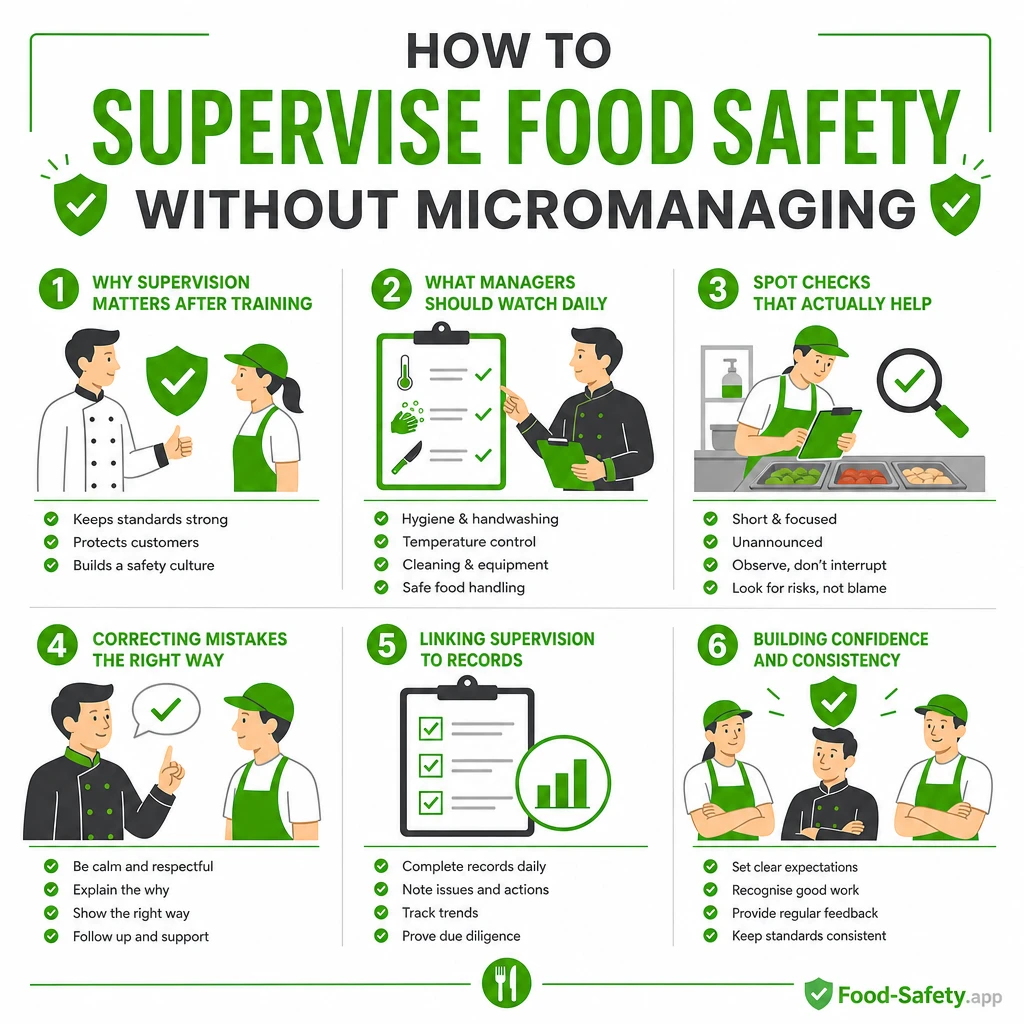
What good practice looks like includes quick, daily checks, clear ownership, and visible, timestamped records that travel with the shift handover. For instance, the head chef may notice a fridge running warm and record the action taken, then adjust the thermostat and log the event for continuity. Staff training reinforces these habits.
What to watch daily in a busy kitchen
Daily vigilance is the backbone of safe service. Focus on controls that have the greatest impact on safety and guest wellbeing.
- Temperature control across cooking, chilling, cooling, reheating, and hot holding
- Handwashing hygiene and accessible stations
- Cross-contamination risks between raw and ready-to-eat items
- Cleaning standards and end-of-day rechecks
- Allergen handling and accurate labelling
- Delivery checks and goods-in procedures
For official guidance on temperature control, see our related guide on hygiene ratings.
Spot checks that actually help
Spot checks are short, targeted checks that reveal issues before service. Use a small, repeatable set of checks at key moments to keep the kitchen aligned with standards, without turning inspections into a burden.
- Fridge controls: verify door seals, correct temperatures, and log readings.
- Hot holding: ensure temperatures stay above safe thresholds during service.
- Cooling: monitor time-to-cooling and container sizing to maintain rapid, safe cooling.
- Cleaning tasks: confirm completion and surface cleanliness with quick checks.
- Probe accuracy: check thermometer calibration and proper use for critical measurements.
- Opening/closing routines: confirm all critical controls are set for the day.
Correcting mistakes the right way
Corrective action should be calm, practical and specific. Follow a simple approach: Observe, describe the deviation, explain the fix, demonstrate the correct method, and re-check. Document the outcome and share the learning with the team to reduce repetition and reinforce safe habits.
- Observe the issue without blame.
- Provide clear instructions for the fix.
- Demonstrate the correct method and let staff practise.
- Watch and re-check to confirm compliance.
Linking supervision to records
Structured logs turn daily checks into auditable evidence. Use timestamped entries, note the area and observation, and record the action taken. Store results so inspectors can review trends, accountability is clear, and continuous improvement is visible.
| Date | Area | Observation | Action taken | By | Time |
|---|---|---|---|---|---|
| 20/07/2026 | Fridge 1 | Temperature 2°C above limit | Adjusted cooling, logged | KS | 08:15 |
| 20/07/2026 | Prep area | Missed allergen label | Label applied; issue raised | AS | 10:42 |
Building confidence and consistency
Set clear expectations, keep checks simple, and make responsibility explicit. Rotate ownership so every shift has a point person for a defined set of checks. Use short, visual reminders and quick handovers to sustain momentum across busy services.
Practical examples or scenarios
Head chef notices a fridge running warm and records the action taken, adjusting the thermostat and logging the event for the handover. Supervisor spots a missed allergen label on a prep item and corrects it before service, updating the record. Team leader checks cooling records after service and follows up where times are too slow. Manager reviews cleaning completion and assigns a recheck for a high-risk area. Delivery arrives out of temperature range and is rejected with a goods-in record and note for the supplier.
Enhance your food safety practice
Improve daily food safety with simple, reliable checks and well documented records that inspectors can trust and teams can sustain across shifts.