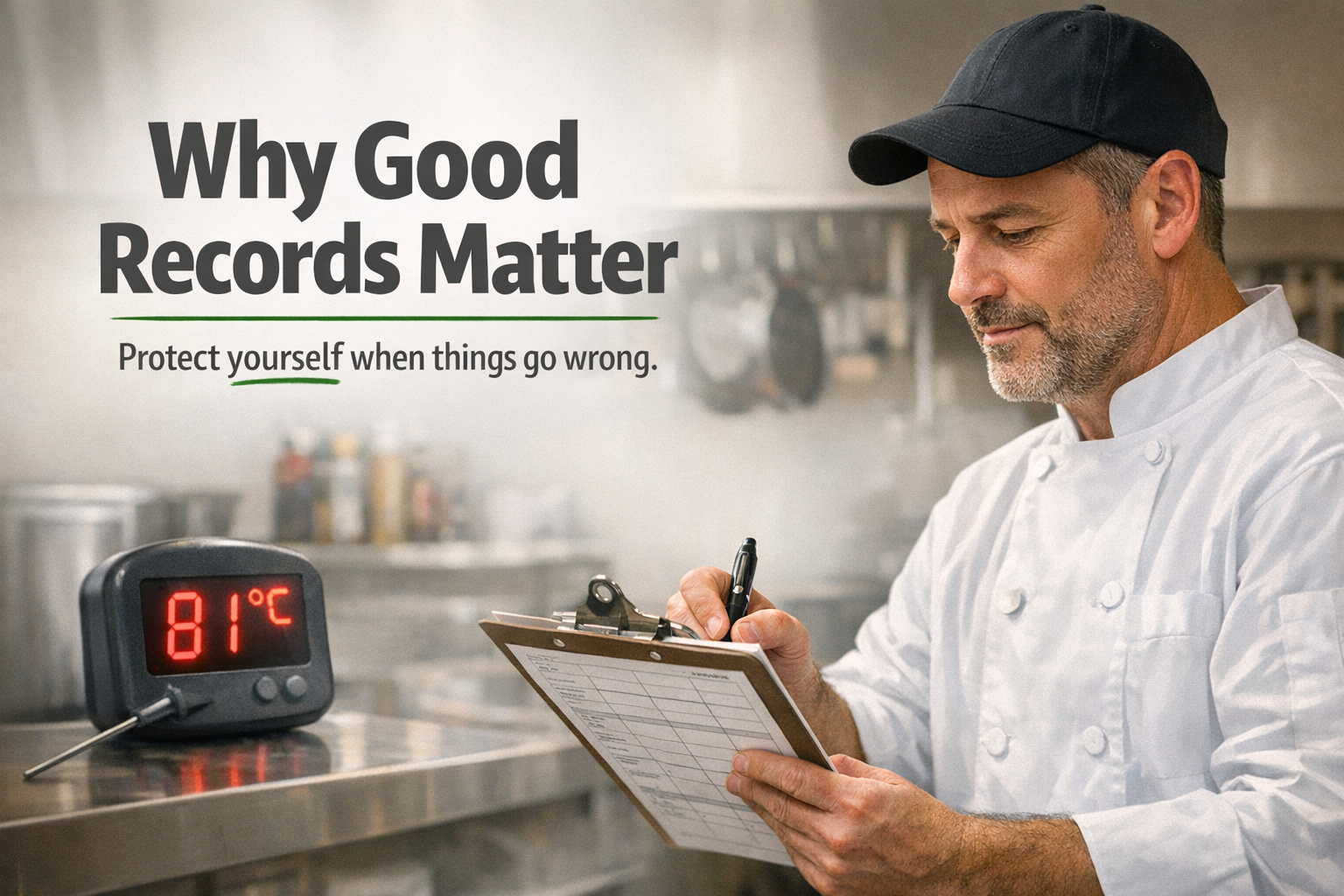
Records in food safety for a small kitchen matter: practical, timestamped records, covering temperatures, traceability, and responsible management, demonstrate due diligence during inspections, incidents and complaints, while staying straightforward for busy shifts. Clear records protect your team and support a compliant operation without turning you into a paperwork shop. Read on for guidance that fits a busy kitchen.
Why records matter
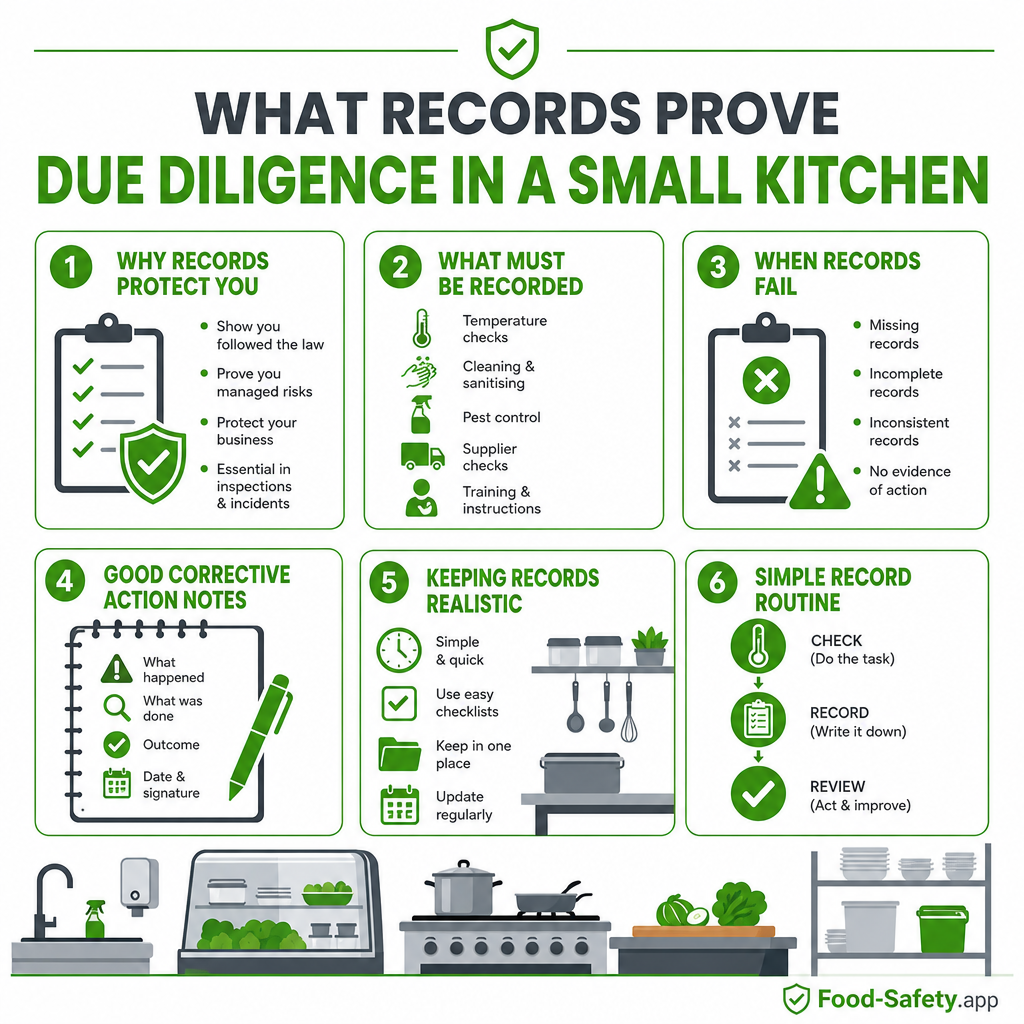
Records are more than paperwork; they are evidence that you control what matters in food safety. They create an auditable trail that shows responsibilities are assigned and followed, and that problems are caught early Natasha’s Law for small food businesses.
In a small kitchen, the daily load is high and checks can be rushed. Good records demonstrate due diligence by documenting when things went right and when adjustments were needed. They improve traceability, help with investigations, and support confident decisions during inspections, incidents or customer complaints. the 4 Cs of food hygiene help shape these practices.
Evidence of control
When temperatures are logged at critical points, you show that cooking, cooling, storage and holding were under control across service.
Traceability and accountability
Each entry links actions to people, times and items, so issues can be traced back to their origin and resolved quickly.
What must be recorded in a small kitchen
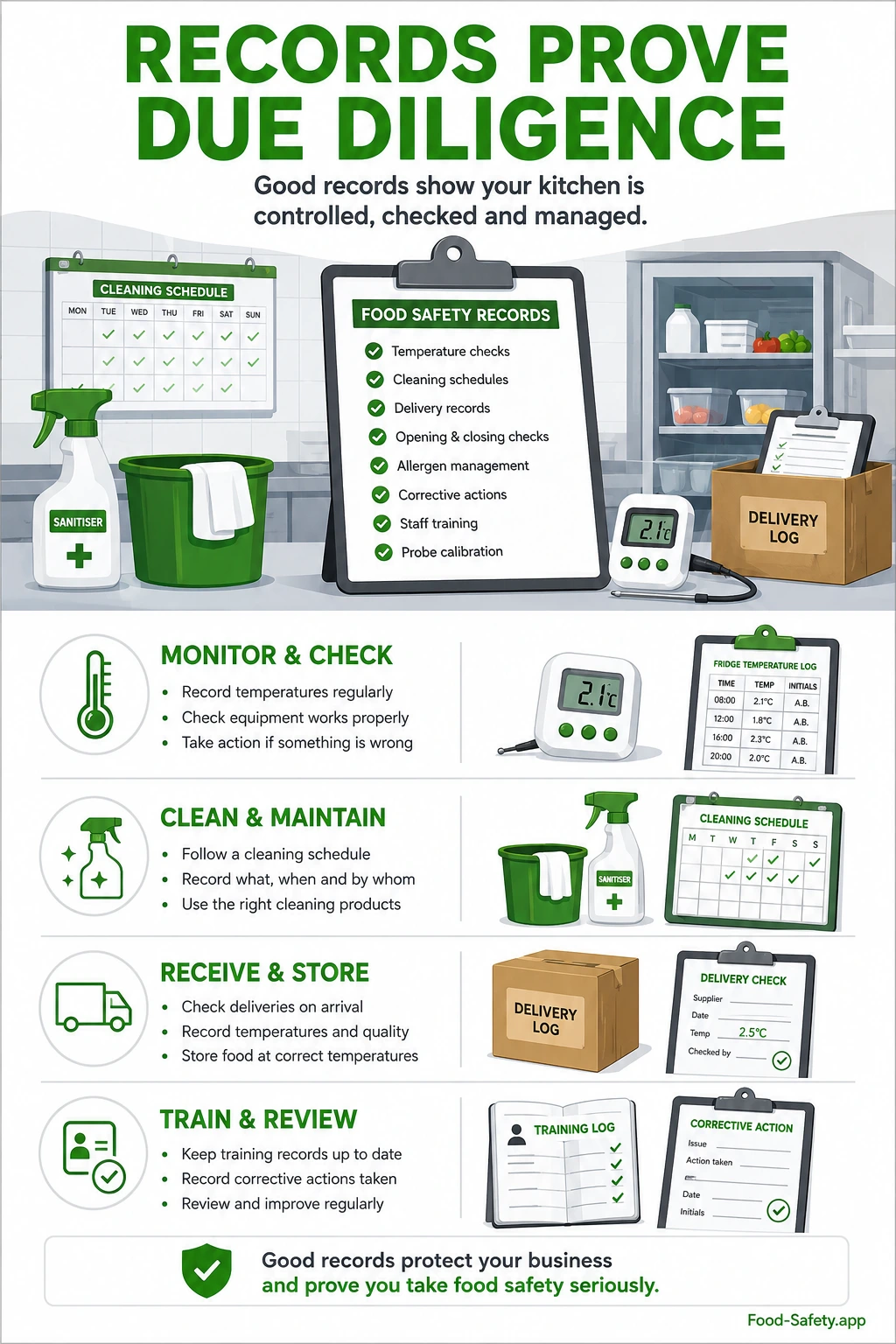
Cooking, cooling, cold storage, reheating and hot holding temperatures
Record temperatures at the end of each step and every meaningful interval. Use a simple format that captures time, item, and temperature. This makes it easy to prove control if a challenge arises.
Opening and closing checks
Document start-up readiness and shut-down completion. Include equipment status, temperature checks, and any actions taken to ready for service or secure the premises after service.
Cleaning completion
Log areas cleaned, date and time, and the person responsible. Note any issues that needed addressing before service resumes.
Delivery checks
Record delivery condition, temperature on arrival, packaging integrity and any discrepancies. Note acceptance or rejection and supplier notification.
Allergens linked to menu items
Link allergen information to each menu item administered or served. Record substitutions or cross-contact concerns observed during service. Allergen labeling guidance.
Defects, corrective actions, probe calibration, pest sightings, and training
Capture defects, equipment faults, broken seals, etc., what corrective actions were taken, who acted, when, and the outcome. Include probe calibration checks and any pest sightings or training updates.
When records fail
Common failures include missing times, vague notes, backfilled entries, unreadable handwriting, and no clear follow-up. When records fail, it becomes harder to defend decisions, justify actions taken, or identify recurring risks.
What good corrective action notes look like
- What went wrong: concise description of the issue.
- What was done: actions taken to resolve or mitigate the issue.
- Who acted: name or role of the staff member responsible.
- Resolution status: confirmation that the problem is resolved or a plan for follow-up.
Keeping records realistic
Record only what matters to the operation. Use simple checks that fit the shift and avoid forms so long they become a bottleneck. The goal is reliable data, not perfect documentation.
Simple record routine
- Start-of-shift checks: temperature checks, equipment status, and logbook sign-off.
- Mid-service temperature checks: spot checks at critical points with brief notes.
- End-of-day cleaning and closure: confirm areas cleaned, locks secured, and records filed.
Practical examples or scenarios
- Fridge above safe limit: log temperature, move food to safe storage, call for repair, and note the outcome.
- Delivery arrives warm or damaged: record condition, reject if needed, and inform the supplier.
- Cooling batch not on target: record time and temperature, split into smaller trays, recheck.
- Pest sighting or equipment fault: log issue and action taken the same day.
Compliance and operational focus
- Food safety management system evidence
- Inspection readiness
- Traceability and audit trail
- Accurate timestamps and consistent completion
Putting it into practice in your kitchen
Small kitchens gain confidence when records are treated as a daily tool, not a box-ticking task. Start with a lightweight routine, train the team to fill in notes promptly, and review records after every service to spot trends before they become problems.
To make this practical for busy kitchens, consider a solution like Food-Safety.app, a food safety management system for catering businesses.
- Use Food-Safety.app, a food safety management system for catering businesses, to record checks, capture corrective actions, and keep a timestamped history offline with no login needed.
- Highlight customisable checks, PDF export, allergen records, and simple daily routines for busy kitchens.
Learn more about food safety records
Explore practical steps to implement lightweight timestamped records in a busy kitchen with a scalable system that keeps compliance simple and effective.