
This guide explains due diligence in a small food business and shows what evidence actually helps if something goes wrong or a complaint is made.
Evidence that demonstrates due diligence
Below are the main record types that demonstrate you are taking reasonable steps to keep food safe. Use them to build a simple, repeatable cycle that the whole team understands.
| Evidence area | What it proves | What good looks like |
|---|---|---|
| Temperature checks | Cooking, cooling, cold storage, reheating and hot holding | Times, temperatures, staff initials, and any follow-up actions recorded |
| Opening and closing checks | Overnight risk control and prep hygiene | Dates and signatures with anomalies addressed |
| Cleaning records | Surfaces and equipment maintained | End-of-shift cleanliness completed, gaps closed with notes |
| Allergen information and menu checks | Allergens tracked for every dish | Allergen matrix linked to menu and supplier data |
| Goods in checks | Deliveries checked for temperature and condition | Any damaged or warm goods rejected or logged with action |
| Defect reports and corrective actions | Non-conformances addressed promptly | Corrective action logged with timescales |
| Probe calibration records | Thermometers accurate for critical checks | Calibration date, due date, initials of technician |
| Pest control records | Facilities monitored for pests | Service visits, findings and follow-up actions |
| Staff training records | Team understands safe handling and allergen management | Training dates, outcomes and refresher plans |
Guidance from public authorities helps shape these practices. See authoritative guidance from the Food Standards Agency for baseline expectations and practical tools suitable for small businesses: Food Standards Agency.
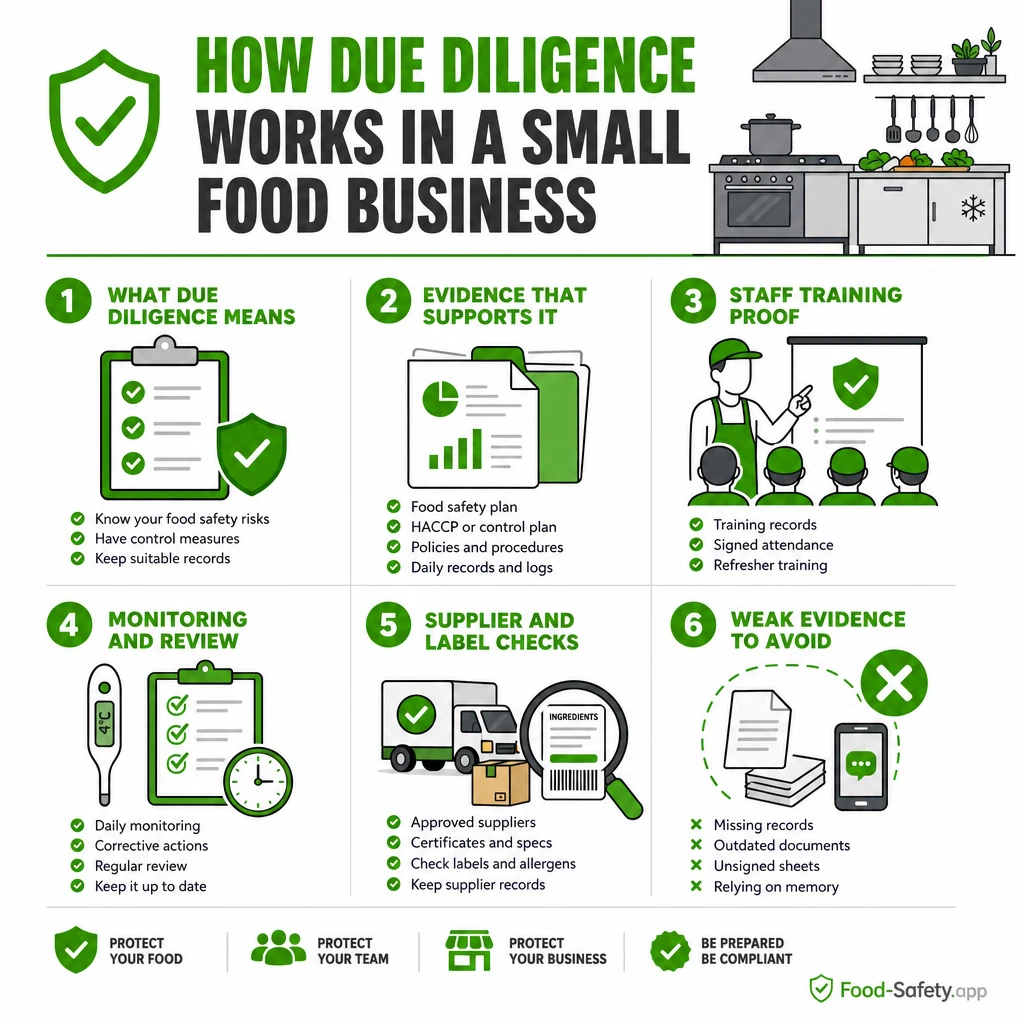
Monitoring and review
Monitoring and review keep your system effective over time. It’s not enough to record checks; you must keep them up to date, spot trends, and act on issues quickly.
Keeping checks up to date
Assign responsibility for daily entries, set clear turnarounds for unresolved items, and perform a quick weekly audit to ensure nothing has slipped through the cracks. If a shift ends with incomplete records, resolve and re-check before the next service.
Spotting trends in errors
Look for repeated mistakes—temperatures that drift, missed cleaning tasks or recurring supplier issues. A simple log that flags recurrent faults helps you target training or supplier conversations before an audit becomes a problem.
Acting on missed temperatures, poor cleaning or delivery issues
Policy should be decisive: recheck affected batches, quarantine or discard unsafe items, recalibrate gear, and record corrective actions with dates and owners. Document the follow-up so inspectors can see you closed the loop.
Supplier and label checks
Supplier and label controls connect your kitchen to external risk points. Clear checks here protect you from receiving unsafe goods or incorrect allergen information.
On arrival checks
Inspect deliveries promptly for temperature, integrity of packaging, and correct paperwork. A failed delivery should be rejected or logged with clear action and a return or replacement plan documented.
Allergen labels and menu records
Ensure delivered products’ allergen labels align with your menu records. If items shift or a product changes, update the allergen matrix and re-train staff on any affected dishes.
Recording non-conformances
Log any non-conformances with the supplier, the action taken and the outcome. Maintain visibility so future deliveries are prevented from repeating the same issue.
Weak evidence to avoid
Avoid establishing compliance on weak or inaccessible records. Common pitfalls include unsigned paper sheets, missing dates and times, incomplete corrective action notes, or “we always do it” without proof. Records that are hard to find during an inspection undermine your whole due-diligence effort.
Practical scenarios and improvements
Fridge found above safe limit during prep
Log the reading, move food to a safe area, investigate the fault, fix the issue, and recheck. Document the root cause and the corrective action taken.
Delivery arrives warm or damaged
Reject the delivery or log the action taken with a note on replacement or vendor contact. Ensure the incident is reviewed to prevent recurrence.
New menu item added
Link all allergens to the dish and review before service. Update records and train staff on any new allergen exposures.
Staff member misses a cleaning task
Record the gap and follow up with the responsible person. Update the cleaning schedule if needed to prevent a repeat.
Practical systems for a busy kitchen
Make records automatic where possible, consistent, and easy to review. Build a simple system that fits a busy kitchen and works offline if the network drops.
- Choose a straightforward, repeatable record system that fits your menu and service style.
- Assign clear responsibilities for opening, during service and closing checks.
- Keep timestamped logs that are accessible to shifts and supervision.
- Use opening and closing checklists to create an auditable trail for inspectors.
- Review performance weekly and adjust processes to close gaps.
Conclusion and how to support due diligence in your operation
Effective due diligence combines practical records, timely action and visible accountability. Build a simple, repeatable cycle that fits your catering environment, supports staff habits, and stands up to inspection. For operators seeking a digital backbone, Food-Safety.app is a food safety management system for catering businesses. It stores timestamped records, tracks checks, logs corrective actions and exports PDFs for inspection proof.
To reinforce your practices, consider these internal resources: Natasha’s Law for Small Food Businesses, Clear allergen labelling on packaged food, and Menu changes that break allergen control. For hygiene and cross-contamination, see How to clean to reduce allergen cross-contact, How to stop cross-contamination in service, and Why staff still get handwashing wrong. Additional reading includes The 4Cs of food hygiene made practical, What are simple food safety tips for busy kitchens, and 10 food hygiene mistakes small kitchens still make.
Digital food safety built for catering businesses
Explore how to streamline safety checks, store timestamped records and prepare audit ready reports with Food-Safety.app for your catering operation today.